Summary
Google Ads is entering a new phase of automation.
For years, advertisers managed campaigns through keywords, manual bidding, audience targeting, and campaign-level optimization. Performance often depended on how well someone could structure campaigns and manage details manually.
That model is changing quickly.
Google is now pushing advertisers toward AI-driven systems that automate targeting, bidding, budget allocation, and optimization decisions at scale. AI Max reflects that larger transition.
For many small businesses, the appeal is obvious. Less manual work, faster optimization, and smarter automation sound like major advantages in an increasingly competitive advertising environment.
But this shift is bigger than another feature update.
Google Ads is gradually moving from campaign-level management toward system-level AI learning. That changes how businesses should think about optimization, strategy, reporting, and long-term performance.
Key Takeaways
Google Ads is becoming increasingly AI-driven, and AI Max reflects a broader shift toward signal-based optimization. Campaign management is becoming less manual and more system-led. Businesses that succeed will likely focus less on complex campaign structures and more on signal quality, conversion tracking, landing page performance, and customer experience.
Google Ads Is Moving Beyond Manual Optimization
Traditional PPC advertising was built around control.
Advertisers manually selected keywords, adjusted bids, segmented audiences, and structured campaigns carefully to improve performance. For years, many competitive advantages came from building highly detailed account structures and optimizing campaigns manually.
But digital advertising has become far more complex.
Consumers now move across Search, YouTube, Maps, Gmail, Discover, and multiple devices before making decisions. Search behavior itself has also changed. Customer journeys are less predictable, attention spans are fragmented, and buying decisions happen across multiple touchpoints.
Google’s response has been consistent for years:
increase automation and allow machine learning systems to optimize using larger behavioral datasets.
AI Max is part of that direction.
What AI Max Actually Represents
AI Max is not simply another campaign feature.
It reflects Google’s broader move toward AI-led advertising systems where machine learning increasingly controls optimization decisions.
Instead of advertisers manually adjusting every variable, the platform increasingly interprets audience behavior, engagement patterns, conversion signals, and predictive intent data automatically.
That changes how campaigns learn.
Historically, optimization focused heavily on keywords, segmentation, manual testing, and bid adjustments.
AI systems increasingly optimize around signals.
This includes conversion quality, engagement behavior, historical activity, audience intent, and predictive learning models.
The shift may appear subtle at first, but structurally it changes how digital advertising operates.
Why Small Businesses Are Interested
For many small businesses, Google Ads has become increasingly difficult to manage manually.
Competition is higher than ever. Costs continue rising across industries. Campaign structures are more demanding and time-consuming to maintain.
AI automation promises simplicity.
Instead of constantly managing bids, keywords, audiences, exclusions, and optimization workflows manually, businesses can increasingly allow the system to automate much of the process.
This is especially attractive for smaller teams without dedicated PPC specialists.
AI systems can process enormous amounts of behavioral data faster than humans can manually optimize campaigns. In some cases, that efficiency can improve performance significantly.
But automation also changes where control exists.
The Trade-Off Between Automation and Transparency
One of the biggest concerns around AI-driven advertising is visibility.
Traditional PPC campaigns allowed advertisers to understand performance through keyword reports, bid analysis, audience segmentation, and campaign-level reporting.
AI systems operate differently.
Machine learning models make optimization decisions using thousands of behavioral signals that advertisers cannot fully see directly.
This creates an important trade-off.
Automation can improve efficiency, but it can also reduce transparency.
Performance becomes harder to explain through isolated variables alone. Many advertisers now experience situations where campaigns perform well, but the exact reasons behind those improvements are less obvious than before.
This is one reason AI-driven advertising feels both exciting and uncomfortable for many marketers.
Why Strategy Matters More Than Ever
A common misconception is that AI automation reduces the importance of marketing strategy.
In reality, strategy may matter more now than before.
As platforms automate execution, competitive advantage increasingly shifts toward the quality of inputs businesses provide.
That includes:
conversion tracking,
creative quality,
landing page experience,
customer intent signals,
and overall positioning.
AI systems still depend heavily on the data and environments they learn from.
Weak landing pages, poor offers, confusing messaging, or low-quality lead data can still damage campaign performance significantly.
Automation cannot fully compensate for weak marketing fundamentals.
In many cases, AI simply amplifies existing strengths and weaknesses faster.
Signal Quality Is Becoming a Bigger Advantage
Modern Google Ads systems increasingly optimize around signals rather than direct manual inputs.
This represents one of the biggest changes happening inside digital advertising today.
The future advantage may not come from building increasingly complicated campaign structures.
It may come from feeding the system cleaner conversion data, stronger CRM integration, higher-quality customer signals, and better post-click experiences.
In other words, signal quality is becoming infrastructure.
Businesses that provide stronger learning environments for AI systems may gain disproportionate advantages over competitors still relying primarily on manual optimization complexity.
Landing Pages Still Matter Deeply
AI can optimize traffic delivery.
It cannot fully fix poor conversion experiences.
Many businesses focus heavily on campaign automation while ignoring landing page quality, trust signals, mobile usability, or offer clarity.
That creates performance limitations regardless of how advanced the advertising platform becomes.
As AI systems optimize faster and more aggressively, the quality of the post-click experience becomes even more important.
Strong advertising still depends on strong customer experiences.
Reporting Is Becoming Less Granular
Another major shift happening quietly inside Google Ads is the gradual reduction of granular reporting visibility.
Historically, advertisers optimized campaigns using highly detailed keyword-level and audience-level data.
AI systems increasingly abstract portions of that information.
This forces businesses to evaluate performance differently.
Instead of focusing entirely on isolated campaign metrics, advertisers increasingly need to monitor broader business outcomes such as lead quality, acquisition efficiency, revenue impact, and customer value.
That requires a more strategic mindset than traditional PPC optimization alone.
What Smart Businesses Are Doing Instead
The strongest advertisers are not blindly resisting automation.
But they are not surrendering strategy either.
Instead, they are improving the quality of the systems surrounding their campaigns.
That includes:
better tracking infrastructure,
cleaner conversion data,
stronger creative testing,
improved landing pages,
and clearer customer journeys.
They understand an important reality:
AI changes how optimization happens.
It does not remove the importance of marketing fundamentals.
If anything, fundamentals matter more because AI systems scale outcomes faster.
The Bigger Direction of Google Ads
AI Max reflects a broader transformation happening across digital advertising platforms.
Campaign management is steadily evolving from manual optimization toward AI-led system learning.
That changes how businesses should think about optimization, testing, reporting, and competitive advantage over the next few years.
The future of Google Ads may not belong to the advertisers building the most complicated account structures.
It may belong to the businesses building the strongest signal environments for AI systems to learn from.
Final Thought
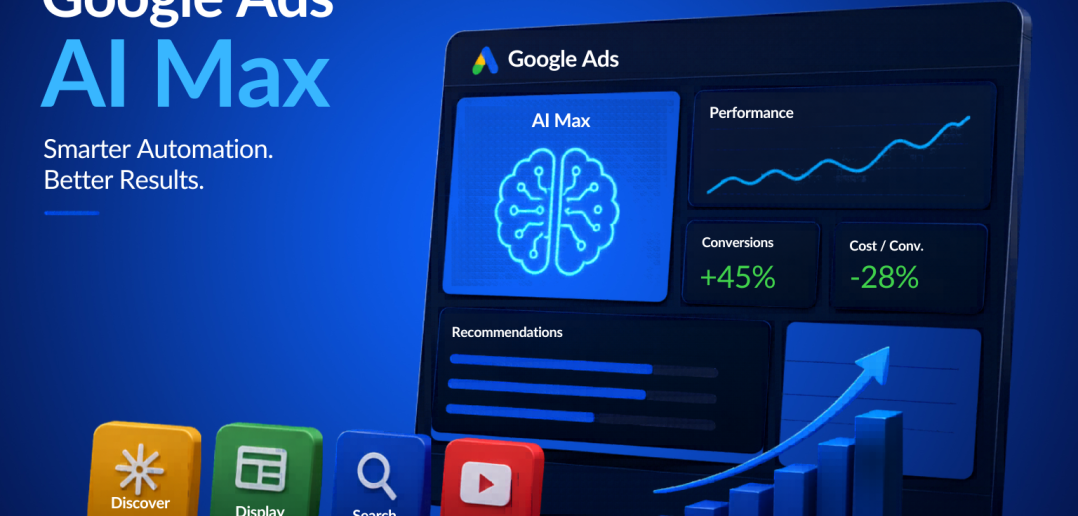
Google Ads AI Max is more than another automation feature.
It reflects a larger shift toward AI-led advertising systems where machine learning increasingly controls optimization decisions.
For small businesses, success will likely depend less on manual complexity and more on signal quality, conversion infrastructure, customer experience, and strategic clarity.
Because AI does not replace strong marketing fundamentals.
It magnifies them.