
For more than a decade, the content calendar has been one of marketing’s most trusted operating tools.
It brought order to chaotic teams. It helped agencies plan campaigns. It gave founders visibility into what would publish next month. It turned content from an occasional activity into a repeatable process.
But in 2026, the assumptions that made the traditional content calendar effective are changing quickly.
Search behavior is shifting faster than monthly planning cycles. AI tools are compressing production timelines. Social platforms are rewarding immediacy. Buyers are discovering brands through more fragmented journeys. And many marketing teams are learning a difficult lesson: being organized does not automatically mean being relevant.
Across industries, brands are still publishing on schedule while missing what their audience actually wants right now.
That is why a growing number of marketers are rethinking the old model of static monthly content planning. The question is no longer whether to plan. It is how to plan in a market that moves in real time.
Key Takeaways
- Traditional monthly content calendars were built for a slower digital environment.
- AI has reduced production timelines, making rigid planning less necessary.
- Many calendars optimize internal workflow rather than external demand.
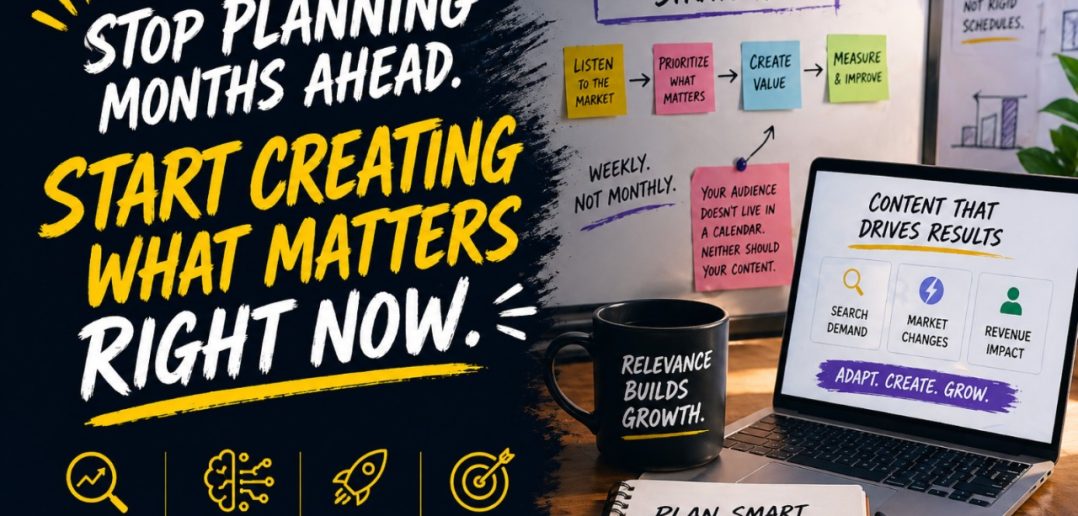
- Smart teams now use search demand, market change, and revenue intent as inputs.
- Weekly editorial systems are replacing static monthly planning.
- Small businesses can gain advantage through speed and relevance.
- AI increases output, but human judgment remains the real differentiator.
The Content Calendar Was Built for a Slower Internet
The traditional calendar emerged in a different era of digital marketing.
Search engine optimization relied heavily on consistent publishing volume. Social media feeds were less saturated. Competition for attention was lower. Blog posts had longer shelf lives. Content creation required more manual coordination across writers, designers, editors, and developers.
In that environment, quarterly themes and monthly publishing schedules made operational sense.
A typical system looked familiar:
- brainstorm topics once a month
- assign deadlines
- batch approvals
- schedule posts weeks in advance
- repeat next month
For many businesses, it worked.
But the modern digital environment no longer rewards predictability in the same way it once did.
What Changed in 2026
Several shifts are colliding at once.
1. Search Intent Moves Faster
Consumer questions now evolve rapidly. Economic pressure, AI adoption, product launches, regulation changes, and platform updates can alter what people search for within days.
A topic that felt timely three weeks ago may now be stale.
2. AI Has Reduced Production Friction
Tasks that once required days can now happen in hours:
- topic research
- outline generation
- draft creation
- repurposing into multiple formats
- metadata creation
- content refreshes
That speed changes planning logic. If content can be created faster, long rigid schedules become less necessary.
3. Platforms Reward Fresh Utility
Whether on LinkedIn, Google, YouTube, or industry newsletters, audiences increasingly respond to content that helps them interpret current changes.
Static educational content still matters. But timely interpretation is gaining value.
4. Buyers Research Across More Channels
Discovery no longer happens in one place. Prospects move between Google, ChatGPT-style assistants, Reddit threads, LinkedIn posts, review platforms, YouTube explainers, and peer recommendations.
That means content strategy must be more responsive and multi-format than many calendars were designed for.
Why Many Content Calendars Quietly Underperform
The problem is not the calendar itself. It is what the calendar often optimizes.
Traditional systems tend to prioritize internal convenience:
- what can be approved early
- what fits the campaign schedule
- what was brainstormed last month
- what leadership requested in advance
They less often prioritize live demand:
- what prospects are asking sales teams this week
- what search terms are rising now
- what competitors are suddenly ranking for
- what new platform feature buyers need explained
- what objections are delaying deals today
This creates a common modern scenario.
A company publishes consistently. The team is disciplined. The calendar is full.
But traffic plateaus, engagement softens, and leads do not meaningfully grow.
The issue is not output.
It is timing and relevance.
AI Is Exposing an Old Inefficiency
One of the clearest impacts of AI in marketing is not writing speed. It is strategic exposure.
When teams can generate content faster, they begin to notice how much time was previously lost to slow planning systems.
Many organizations are now asking:
- Why are we locking topics six weeks early?
- Why are approvals slower than production?
- Why are we publishing ideas before validating demand?
- Why are we measuring volume instead of business impact?
These are healthy questions.
AI is not killing the content calendar. It is revealing where the old version was inefficient.
What Smart Marketers Are Doing Instead
The strongest teams are not abandoning planning. They are replacing static planning with adaptive planning.
Instead of filling an entire month with fixed topics, they operate in shorter cycles with clearer inputs.
They Use Three Core Signals
1. Search Demand
What are people actively trying to solve now?
Examples:
- how AI overviews affect SEO
- best CRM for contractors
- Google Ads for dentists 2026
- local SEO for family law firms
2. Market Change
What just happened that creates confusion or opportunity?
Examples:
- algorithm shifts
- new ad features
- platform policy changes
- AI product launches
3. Revenue Intent
What content supports pipeline and trust?
Examples:
- comparisons
- implementation guides
- ROI explainers
- case-study style education
- objection-handling content
This model keeps strategy aligned with what markets need, not just what calendars contain.
The Rise of Weekly Editorial Systems
Many high-performing teams are moving toward weekly operating rhythms rather than rigid monthly plans.
A common structure looks like this:
Monday: Intelligence Review
Check:
- search console trends
- sales objections
- competitor publishing patterns
- industry news
- customer questions
- campaign performance
Tuesday: Prioritization
Decide what deserves immediate attention.
Wednesday to Friday: Publish and Repurpose
Turn one strong insight into:
- article
- LinkedIn post
- email note
- short-form social content
- sales enablement asset
Friday: Performance Review
Measure:
- rankings
- clicks
- engagement quality
- leads
- assisted conversions
This creates momentum without losing discipline.
Why Small Businesses May Benefit the Most
Large enterprises often struggle to move quickly. Layers of review slow reaction time.
Small businesses and lean marketing teams can use that to their advantage.
A local agency, law firm, home service brand, clinic, or SaaS company can publish relevant interpretation while larger competitors are still scheduling meetings.
For example:
- What Google’s Latest Search Change Means for Roofers
- New Instagram Discovery Trends for Realtors
- AI Search and the Future of Family Law SEO
- How Local Clinics Can Use Meta Lead Updates
Speed plus usefulness can outperform size.
But Calendars Still Matter in Some Cases
It would be simplistic to declare content calendars obsolete.
They remain valuable for:
- product launches
- seasonal campaigns
- webinar promotion
- compliance-heavy industries
- multi-stakeholder approvals
- brand campaigns requiring coordination
The shift is not from planning to improvisation.
It is from fixed planning to flexible planning.
That distinction matters.
The Hidden Risk of AI-Era Content Strategy
There is also a countertrend marketers should take seriously.
As AI makes publishing easier, many brands will produce more content with less originality. Feeds may become fuller but less memorable. Search results may become more repetitive.
That creates a premium on human judgment.
Winning teams will not simply publish faster. They will publish sharper.
They will know:
- which topics matter
- what angle is fresh
- where commercial intent exists
- how to add perspective competitors missed
Speed without insight can create noise.
How to Modernize Your Content Strategy in the Next 30 Days
Week 1: Audit Your Existing Calendar
Label planned topics:
- timely
- evergreen
- low priority
- outdated
- replaceable
Week 2: Build Live Inputs
Track weekly:
- customer FAQs
- sales calls
- search movement
- competitor content
- industry updates
Week 3: Adopt a 70/20/10 Mix
- 70% evergreen revenue content
- 20% trend-responsive content
- 10% experiments
Week 4: Measure Outcomes That Matter
Go beyond pageviews.
Track:
- leads
- qualified inquiries
- assisted conversions
- ranking gains
- sales usage of content
A Better Definition of Content Planning for 2026
Old model:
Plan content early and publish consistently.
New model:
Use live market signals to produce relevant content quickly while protecting quality and strategic focus.
That is a more demanding model.
But it is also a more profitable one.
Final Thought
The content calendar is not disappearing because planning failed.
It is being challenged because markets became faster than static systems.
In 2026, marketers who win will combine structure with responsiveness, AI speed with editorial judgment, and consistency with real-time relevance.
The future belongs to teams that know not only what to publish next month, but what deserves to be published this week.
FAQs
Are content calendars still useful in 2026?
Yes, especially for launches, campaigns, and coordinated initiatives. But static monthly systems alone are less effective.
What should replace a traditional content calendar?
A flexible planning model using weekly insights from search demand, customer questions, and market changes.
Does AI remove the need for strategy?
No. AI accelerates execution. Strategy still determines what should be created and why.
How often should content priorities be reviewed?
Weekly is increasingly ideal in fast-moving markets.
What matters more now: consistency or relevance?
Both matter, but relevance is becoming the stronger growth lever when attention is limited.