In many U.S. cities today, a simple pattern is playing out across local search results.
Search for a service like “family lawyer near me,” “roof repair,” or “chiropractor,” and a cluster of businesses appears in the local map pack. At first glance, the differences seem subtle. Similar ratings. Comparable services. Overlapping geographies.
But look closer, and one distinction becomes hard to ignore.
The businesses that continue to appear consistently are not always the oldest, the largest, or even the highest-rated.
They are the ones that look active.
Profiles with a steady stream of recent reviews, ongoing customer feedback, and visible engagement tend to hold their position more reliably than those with large but stagnant review counts.
This is not a formal rule published by Google. But across industries, it has become one of the more consistent patterns shaping local visibility in 2026.
Key Takeaways
- Review consistency is becoming as important as total review volume.
- Recency signals help both users and search systems assess current relevance.
- Review velocity reflects ongoing customer activity and influences visibility patterns.
- User-generated content in reviews strengthens semantic relevance.
- Manual review collection often leads to inconsistent growth.
- System-driven approaches help maintain steady review flow over time.
- Reviews now function as both a ranking signal and a conversion driver.
From Static Reputation to Ongoing Activity
Local SEO has traditionally been explained through three factors: relevance, proximity, and prominence.
Reviews have always influenced prominence. More reviews generally meant more trust, and more trust often translated into better visibility.
What has changed is how that trust is interpreted.
A business with hundreds of reviews built over several years still signals credibility. But if those reviews taper off, the signal begins to lose immediacy. The profile starts to reflect past performance rather than current demand.
In contrast, a competitor with fewer total reviews but consistent recent activity presents a different kind of signal. It suggests that customers are still choosing that business today, not just historically.
That distinction is becoming more important.
Why Recency Is Becoming a Deciding Factor
The increasing weight of recency reflects a broader shift in how digital platforms evaluate relevance.
Search systems are no longer optimizing only for accuracy. They are optimizing for usefulness in the present moment.
For local services, usefulness is tied closely to availability, reliability, and recent customer experience.
A listing with fresh reviews answers implicit user questions:
- Are people still using this business?
- Are outcomes still consistent?
- Has anything changed recently?
These are not technical SEO questions, but they influence behavior directly.
When multiple listings appear similar, users tend to gravitate toward the one that feels most current. That preference feeds back into engagement signals such as clicks, calls, and direction requests, reinforcing visibility over time.
The Emergence of Review Velocity
Within this context, marketers have begun to describe a concept that is not formally defined by Google but increasingly observed in practice: review velocity.
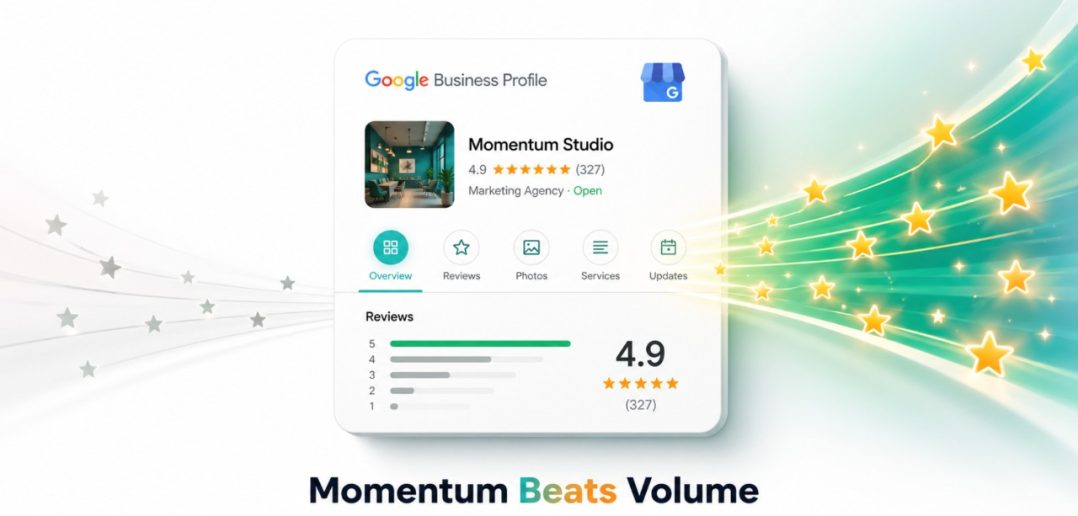
Review velocity refers to the pace and consistency at which new reviews are generated.
Two businesses may have similar ratings and services, but very different velocity patterns:
- Business A receives 80 reviews in a two-month campaign and then slows down
- Business B receives 6 to 8 reviews every month consistently
Over time, Business B often appears more stable in local rankings.
The reason is not simply volume. It is pattern.
Search systems appear to respond more favorably to signals that resemble real-world activity rather than artificial bursts.
Consistency suggests ongoing customer interaction. Spikes followed by inactivity suggest something else.
The Limits of Rating as a Differentiator
Star rating still matters. A business with a 4.9 rating will generally outperform one with a 3.8 rating, all else equal.
But within narrower bands, rating alone is becoming less decisive.
In many competitive markets, most businesses operate between 4.3 and 4.9. The difference between a 4.7 and a 4.8 is often less meaningful to users than the difference between a profile updated last week and one last updated six months ago.
This is particularly visible in service categories where trust is built through recency:
- healthcare providers
- legal services
- home services
- auto repair
In these sectors, buyers are less interested in perfection and more interested in predictability.
Recent reviews provide that signal.
Reviews as Search-Relevant Content
Another underappreciated aspect of reviews is their contribution to search relevance itself.
Each review adds language that reflects how customers describe a service. Over time, this creates a layer of user-generated content that complements traditional SEO efforts.
For example, a dental clinic might repeatedly receive reviews mentioning:
- “emergency appointment”
- “same-day treatment”
- “pain relief”
These phrases are not always engineered into the website with precision. Yet they accumulate naturally in reviews, strengthening the listing’s relevance for related queries.
This dynamic has become more important as search systems rely on broader context rather than exact keyword matching.
Reviews effectively become a continuous source of semantic enrichment.
Why Many Businesses Plateau
Despite understanding the importance of reviews, many small businesses reach a plateau.
They gather an initial base of reviews, often through a focused push, and then slow down.
The reasons are usually operational rather than strategic:
- staff forget to ask consistently
- follow-up processes are inconsistent
- timing of requests is not optimized
- customer willingness varies
- no system ensures coverage across all customers
As a result, review generation becomes sporadic.
This creates a pattern that does not align with how search visibility appears to reward activity.
The issue is not awareness. It is sustainability.
The Shift Toward System-Driven Review Growth
To address this, many businesses are moving away from manual review collection and toward structured systems.
The idea is simple: if reviews matter consistently, the process that generates them must also be consistent.
Instead of relying on individual behavior, review requests are embedded into customer workflows.
This might include:
- automated follow-ups after a service
- timed reminders based on interaction
- standardized outreach across all customers
Platforms such as Propel have emerged to support this shift. Their role is not to change what is being asked, but to ensure that it happens reliably.
In practice, this turns review generation from an occasional effort into a background process.
The effect is not dramatic in the short term. But over months, it creates the kind of steady review flow that aligns with both search patterns and user expectations.
Engagement as a Secondary Signal
Another dimension that is gaining attention is how businesses respond to reviews.
While response behavior alone does not guarantee higher rankings, it contributes to overall profile activity.
A listing that shows:
- timely responses
- acknowledgment of feedback
- consistent engagement
appears more active than one where reviews accumulate without interaction.
From a user perspective, this suggests accountability.
From a search perspective, it adds another layer of ongoing activity.
The Competitive Gap Is Widening
In many local markets, a small number of businesses are beginning to separate from the rest.
This separation is not always due to better services. It is often due to better signal management.
Businesses that maintain:
- steady review velocity
- consistent engagement
- updated profiles
tend to create a compounding advantage.
As they receive more reviews, they attract more clicks. As they attract more clicks, they generate more customers. As they generate more customers, they generate more reviews.
This loop reinforces itself.
Meanwhile, businesses with irregular activity struggle to regain momentum, even if their core offering is strong.
Rethinking Reviews as Infrastructure
The underlying shift is conceptual.
Reviews are no longer just a reputation asset. They are part of the operational infrastructure of local marketing.
They influence:
- visibility
- user trust
- click behavior
- conversion decisions
Treating reviews as a one-time milestone does not align with how these systems work.
Treating them as an ongoing process does.
What This Means for 2026 and Beyond
Local SEO is becoming more dynamic.
Static optimization techniques, while still important, are being complemented by signals that reflect real-world activity.
Reviews sit at the intersection of these signals.
They capture customer experience, update continuously, and influence both algorithms and human decisions.
As competition increases and attention becomes more limited, the businesses that maintain consistent visibility will likely be those that maintain consistent signals.
In that context, review volume is no longer just a number.
It is a timeline.
FAQs
Do Google reviews directly impact local rankings?
They contribute to prominence and influence visibility, particularly when combined with recency and consistency.
What is more important, rating or recency?
Both matter, but in competitive markets, recent activity often becomes a deciding factor between similar listings.
How many reviews should a business aim for each month?
There is no universal number, but consistent growth is more effective than irregular spikes.
Can older reviews lose value over time?
They still contribute to overall credibility, but their influence may diminish if not supported by recent activity.
Is responding to reviews necessary?
While not mandatory, consistent responses can improve user perception and signal active engagement.