
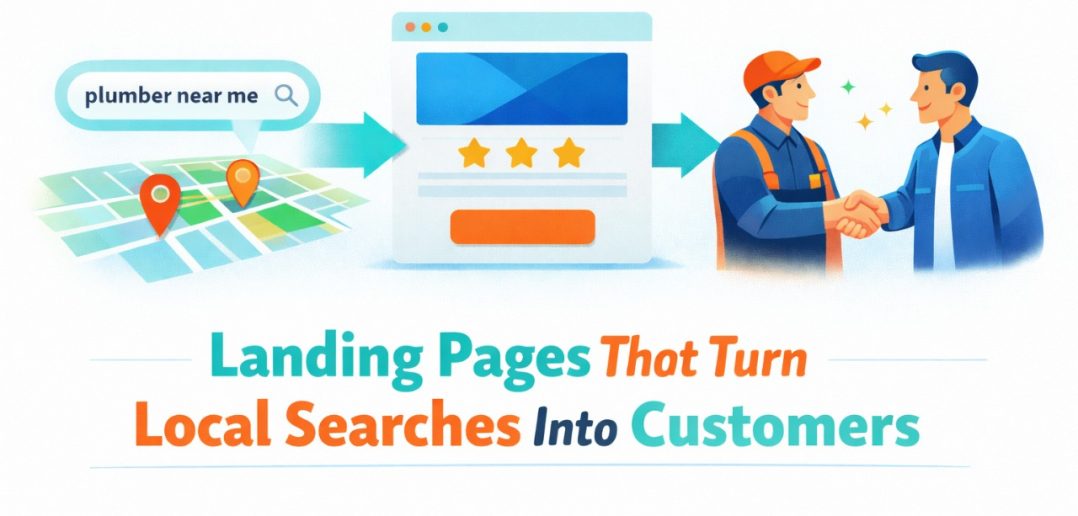
If you run a local service business, chances are your customers find you through search.
Think about the kinds of queries people type into Google:
“plumber near me”
“roof repair Dallas”
“emergency electrician Chicago”
These searches carry strong intent. The person searching usually isn’t browsing casually, they’re trying to solve a problem right now.
This is why landing pages matter.
Sending visitors to a generic homepage forces them to hunt for information. A dedicated landing page, on the other hand, answers the exact question they searched for. It confirms the service, proves local credibility, and makes it easy for them to contact you.
And the opportunity is huge. Local landing pages help businesses capture search traffic from people actively looking for nearby services and convert that traffic into customers.
When built correctly, these pages become one of the most reliable lead sources for local businesses.
Key Takeaways
- Local landing pages work best when they target service + location search intent, like “roof repair Dallas” or “plumber near me.”
- Dedicated pages improve both search visibility and conversions because they answer specific local queries.
- Trust signals such as reviews, photos, and consistent contact information help visitors feel confident contacting your business.
- Each service or service area should ideally have its own page rather than sending all traffic to one homepage.
- A strong landing page balances local SEO optimization and conversion design.
Why Local Landing Pages Matter
Local search is fundamentally different from general search.
When someone searches for “marketing strategy,” they might be researching ideas.
But when someone searches for “HVAC repair Denver,” they are usually looking to hire someone.
This is called local search intent, the user’s goal of finding a nearby service or business to solve a problem.
Search engines prioritize results that match both the service and the location.
That’s why local landing pages exist.
Instead of one broad page describing everything your business does, these pages focus on a specific combination of service and geography. For example:
Roof Repair in Miami
Personal Injury Lawyer Houston
Garage Door Repair Phoenix
These pages signal relevance to search engines while helping customers instantly confirm they’re in the right place.
And they work.
Local landing pages often convert better than generic pages because they match the exact intent of the search.
What Makes a High-Converting Local Landing Page?
Most successful local landing pages follow a similar structure.
Not because marketers love templates but because the structure aligns with how people make decisions online.
Visitors typically go through three quick mental steps:
- Am I in the right place?
- Can I trust this business?
- How do I contact them?
Your landing page should answer those questions quickly.
The typical structure looks like this:
- clear service + location headline
- proof and credibility signals
- service explanation
- local context
- reviews or testimonials
- strong call to action
Each section exists to move the visitor one step closer to contacting you.
Step 1: Start With Local Search Intent
The first step in building a landing page is understanding what your customers actually search for. Most local queries follow a simple pattern: Service + Location
Examples include:
HVAC repair Phoenix
plumber Austin
roof replacement Tampa
These keywords are powerful because they usually signal someone ready to take action.
Search engines detect these patterns and try to match users with nearby businesses that provide the service.
Your landing page should target one of these search patterns. For example:
/plumbing-dallas
/roof-repair-miami
/electrician-chicago
When the page structure matches the query structure, search engines understand the relevance instantly.
Step 2: Write a Headline That Confirms the Location
Your headline should remove doubt immediately.
Visitors need to know two things within seconds:
what service you provide
where you provide it
For example:
Emergency Plumbing Services in Dallas
or
Reliable Roof Repair in Miami
Avoid vague headlines like:
“We Fix Problems Fast”
Clarity beats creativity here.
The visitor should feel like the page was built specifically for them.
Step 3: Establish Local Trust Quickly
After the headline, visitors want reassurance.
They want to know they’re dealing with a real business serving their area.
This is where local credibility comes in.
Examples include:
- years of service in the area
- certifications or licenses
- number of completed projects
- awards or local recognition
You can also add:
Google reviews
customer testimonials
project photos
These signals reduce hesitation and increase the likelihood of someone contacting you.
Step 4: Explain the Service Clearly
One mistake many landing pages make is jumping straight into sales language.
Visitors first want to understand the service.
For example, a plumbing page might explain:
- leak detection
- pipe replacement
- emergency repairs
- water heater installation
This section should answer the questions customers typically ask before hiring a provider.
Clear explanations also help search engines understand the topic of the page.
Step 5: Add Local Context
This is where many landing pages fail.
Businesses often duplicate the same page across multiple cities and simply change the city name.
Search engines recognize this instantly.
Instead, make the page feel genuinely local.
Talk about:
- neighborhoods you serve
- regional weather challenges
- local building styles
- common local problems
For example, a roofing company in Florida might discuss hurricane damage.
A plumbing company in Chicago might mention frozen pipes.
Local context signals relevance and builds trust with nearby customers.
Step 6: Add Reviews and Proof
For service businesses, trust often determines whether someone calls.
That’s why reviews are critical.
Include:
- Google review excerpts
- testimonials
- before-and-after project photos
- case results
Reviews act as social proof.
They show visitors that others in their area have trusted your business before.
Step 7: Use a Strong Call to Action
A landing page should guide visitors toward a single action.
That action might be:
Call now
Get a free quote
Book an appointment
Place the call to action prominently.
Many effective landing pages include the phone number at the top of the page and repeat the call-to-action throughout the page.
The easier it is to contact you, the more leads you’ll generate.
Step 8: Include Clear Business Information
Local search engines rely heavily on consistent business details.
Every landing page should include:
- business name
- address
- phone number
- service areas
- business hours
This information helps search engines verify your business and improves local search visibility.
It also reassures visitors that your business is legitimate.
Step 9: Optimize for Mobile
Most local searches now happen on mobile devices.
Someone searching for “electrician near me” is often doing it from their phone.
That means your landing page must:
- load quickly
- display clearly on mobile
- include click-to-call buttons
If contacting your business requires zooming, scrolling, or hunting for a phone number, you’ll lose leads.
Common Mistakes to Avoid
Many businesses unknowingly sabotage their landing pages.
Common mistakes include:
- duplicating the same content across cities
- hiding the phone number
- slow loading speeds
- weak headlines
- missing trust signals
A landing page should feel like the obvious solution to a local problem.
If it doesn’t, visitors will move to the next result.
FAQs
What is a local landing page?
A local landing page is a page designed to target a specific service and geographic location, helping businesses appear in local search results.
Do local landing pages improve SEO?
Yes. They improve visibility for location-based searches and help search engines match your business with nearby customers.
Should each service have its own page?
In most cases, yes. Separate pages allow businesses to target different search queries more precisely.
Conclusion
Local service businesses live and die by visibility.
When someone searches for help in their city, they usually choose one of the first few businesses they see.
Landing pages help you appear in those searches and convert visitors into real customers.
The formula is straightforward:
match search intent
confirm location
build trust quickly
make contacting you easy
When those elements come together, a landing page stops being just another webpage. It becomes a steady source of new leads.