| Summary: Local SEO is the art of making your business show up when people search for services in their area. According to Moz’s annual Local Search Ranking Factors Study, the top signals that influence where your business lands in Google’s local results include your Google Business Profile (GBP), the quality and quantity of backlinks, on-page content quality, local citations (NAP consistency), customer reviews, and behavioral signals like click-through rates. Proximity to the searcher still plays a role, but it’s only one piece of a much larger puzzle. Businesses that get all these elements working together, even in competitive verticals like plumbing, consistently outrank competitors who rely on proximity alone. This article breaks down each factor, explains why it matters, and shows you what real-world local domination looks like. |
Picture this: someone’s pipe bursts at 8 PM on a Tuesday. They grab their phone, type “plumbing near me”, and the first non-ad result they see is a business they’ve never heard of before. They call. The job gets done. That business didn’t end up there by accident.
Local search is one of the most fiercely competitive digital spaces out there, and yet, a lot of local business owners still think it comes down to luck or how close they are to the customer. It doesn’t. There’s a specific formula, and once you understand it, the path to the top becomes a lot clearer.
This is exactly what Moz’s Local Search Ranking Factors Study has been documenting for years, surveying dozens of local SEO experts to understand which signals Google weighs most heavily when deciding who earns that coveted first position on the results page.
The Two Battlefields: Local Pack vs. Organic
Before we dive into the ranking factors themselves, it helps to understand that local search results are split into two distinct areas. The first is the Local Pack (also called the 3-Pack or Map Pack) that block of three business listings that appears with a map at the top of search results. The second is the local organic section, the traditional blue-link results that appear directly beneath it.
Both matter. And here’s something most people don’t realize: the factors that influence your Local Pack ranking are different from those that push you up in organic results. Google treats them differently because they serve different user intents. Understanding this distinction is half the battle.
For searches like “plumbing near me,” the map pack often dominates the top of the page, usually right after any paid ads. But the organic results directly below it carry serious weight too. Businesses that manage to claim real estate in both areas are essentially doubling their visibility without spending a single extra dollar on ads.
The Ranking Factors That Actually Matter
Let’s walk through the core signals that Moz’s research consistently identifies as the biggest movers in local search. Think of these not as a checklist, but as an interconnected system, each one feeding into the others.
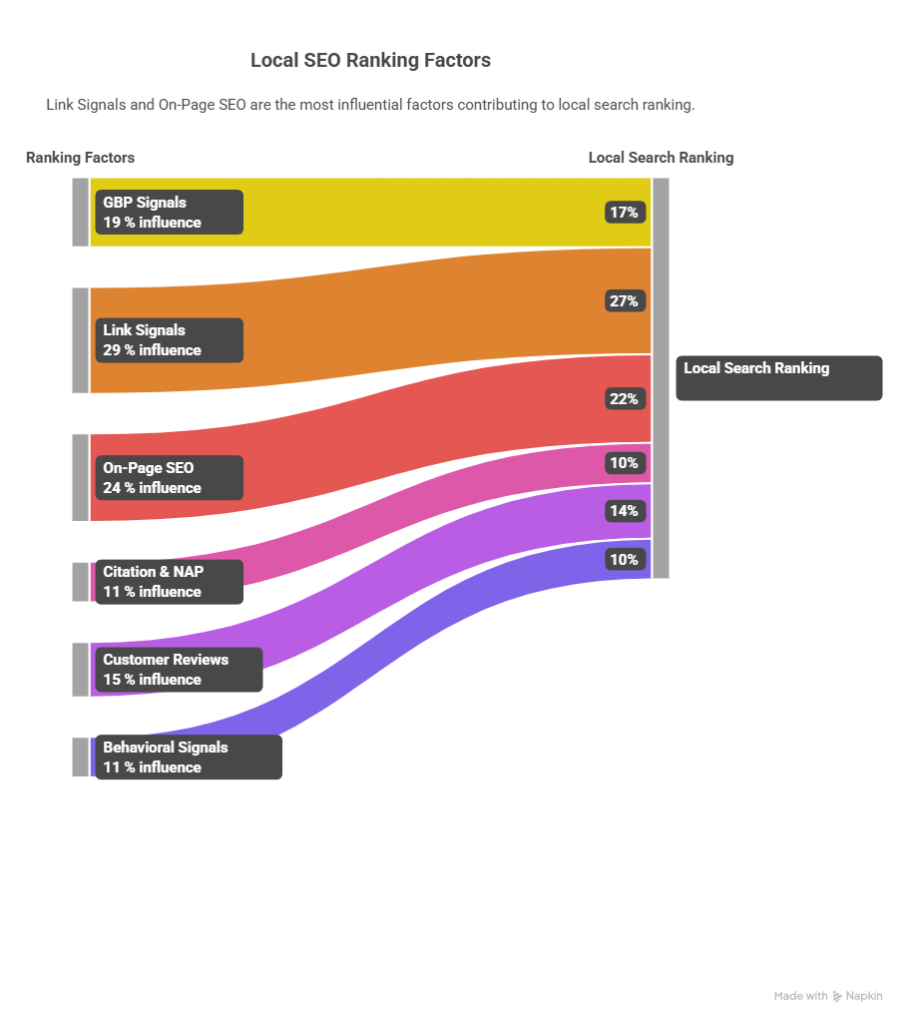
- Factor 01: Google Business Profile Signals (~19% influence) Category accuracy, keyword relevance in your business name, completeness of information, and regular posting activity all play a role here.
- Factor 02: Link Signals / Backlinks (~29% influence) The quantity and quality of external sites linking to yours. A mention from a trusted local directory or news outlet carries enormous weight.
- Factor 03: On-Page SEO Signals (~24% influence): Your website’s title tags, meta descriptions, NAP presence, header structure, and localized content targeting your service area.
- Factor 04: Citation & NAP Consistency (~11% influence) Consistent Name, Address, and Phone number across all directories. Even small inconsistencies, like “St.” vs “Street,” can erode trust signals.
- Factor 05: Customer Reviews (~15% influence) Review volume, recency, response rate, and sentiment on Google. Reviews are trust signals both for Google’s algorithm and for real humans deciding whether to call.
- Factor 06: Behavioral Signals (~11% influence) Click-through rates, mobile clicks-to-call, direction requests, and dwell time. Google watches how users interact with your listing and your website.
Your Google Business Profile: The Foundation of Everything
If there’s one thing you take away from this entire article, let it be this: an incomplete or neglected Google Business Profile is the single most common reason local businesses fail to appear in the top results. It’s that straightforward.
Think of your GBP as your digital storefront on Google; it’s often the very first impression a potential customer gets before they even visit your website. The businesses that treat it seriously, updating their hours, responding to every review, posting photos regularly, and selecting the right primary category are the ones that consistently hold top positions.
| “Optimizing your Google Business Profile isn’t a one-time task. It’s an ongoing commitment that tells Google and your customers that you’re active, trustworthy, and ready to serve.” Local SEO Best Practice, Moz Study Reference |
For a business in the home services space, plumbing, for instance, the difference between a bare-bones GBP and a fully fleshed-out one can be the difference between page one and page three. Category selection matters enormously here. Choosing “Plumber” vs. “Plumbing Service” vs. “Emergency Plumber” can affect which queries you’re even eligible to appear for.
A Real-World Look: What Organic Dominance Looks Like
Take a moment to search for “plumbing services near me” in a densely populated area and observe what happens. You’ll see sponsored ads at the very top of businesses that are paying for that spot. Below those ads, the Local Pack appears with its map and three businesses. But scroll just a little further, and you hit the organic results, and that’s where things get genuinely interesting.
The businesses holding those top organic spots aren’t there because they paid for placement or because they happen to be the closest to you geographically. They’re there because every single signal Google cares about, backlinks, on-page quality, citations, reviews, and engagement data points to them as the most relevant and trustworthy answer for your query.
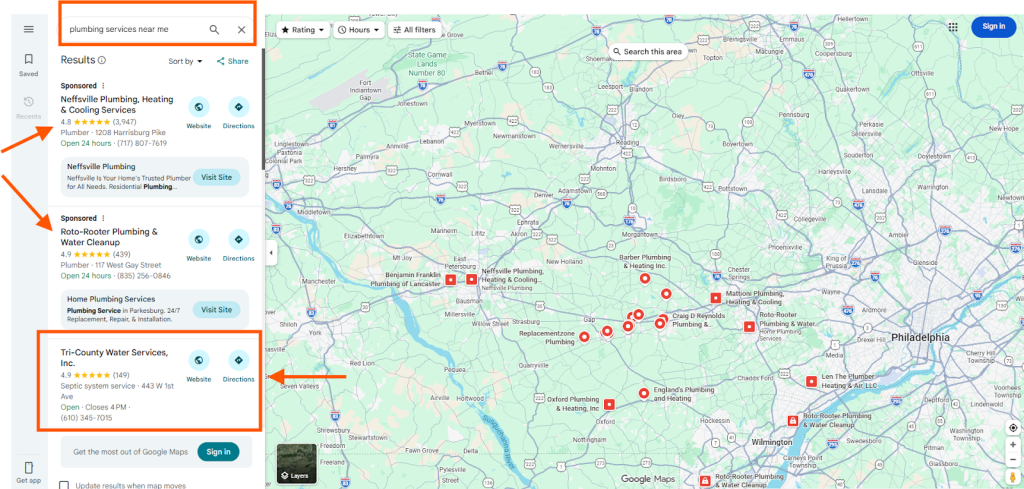
A good example of this in practice is a business like Tricowater.com, a local plumbing and water services provider that has methodically built its online presence. When you search for plumbing services in their area, they consistently surface in that organic zone right beneath the sponsored listings, not because of budget, but because of execution. Their GBP is dialled in, their website earns relevant backlinks, their NAP data is consistent across directories, and their review profile reflects a genuine track record of service.
| Worth noting: Appearing organically right below sponsored ads is arguably more powerful than the ads themselves. Organic results carry an implied trust that paid listings don’t; most users know the difference, and many consciously skip ads in favour of the first organic result. |
The Role of Backlinks Still Critical in 2026
There’s a persistent myth in local SEO circles that backlinks don’t matter at the local level, that it’s all about your GBP and citations. Moz’s research dispels this firmly. Link signals account for nearly a third of organic local ranking factors, making them the single largest contributor.
What kinds of links matter most for local businesses? Local news mentions, industry directory listings, chamber of commerce features, supplier websites, and local blog references all carry genuine value. The key isn’t volume, it’s relevance and domain authority. One link from a well-regarded local publication is worth more than a dozen low-quality directory submissions.
On-Page SEO: Don’t Overlook the Basics
Your website still needs to do the heavy lifting when it comes to communicating relevance. This means ensuring your service pages use natural language that reflects how real people search phrases like “emergency plumber in [city]” worked into headings, body copy, and meta tags without sounding robotic.
Every page should have a clear, keyword-relevant title tag, a compelling meta description, and your business’s full name, address, and phone number visible ideally in the footer of every page. If you serve multiple neighbourhoods or cities, dedicated landing pages for each service area can compound your visibility significantly over time.
Reviews: The Social Proof Algorithm
Google treats reviews as one of the clearest signals of real-world trust and quality. Businesses with a steady stream of recent, positive reviews consistently outperform those with older or sparser review profiles, even when the older business has more total reviews.
The smartest operators build review generation into their service process itself, a follow-up text message after a job is completed, and a polite request at the point of service. It doesn’t need to be complicated. It just needs to be consistent.
And don’t ignore the responses. Replying to reviews, both positive and negative, signals to Google that your business is engaged and attentive. For negative reviews, especially, a calm and professional response can actually improve conversion rates by demonstrating how you handle problems.
Frequently Asked Questions
Q.1 What is the single most important local SEO ranking factor?
There’s no single silver bullet, but if you had to pick one starting point, your Google Business Profile is it. According to Moz’s Local Search Ranking Factors Study, GBP signals have a significant influence on where you appear in the Local Pack. An incomplete or inaccurate profile is one of the fastest ways to lose visibility, and getting it right is one of the fastest ways to recover ground.
Q.2 How does proximity affect local rankings? Does location still matter?
Proximity matters, but it’s far from the only factor. Google does favour businesses that are physically close to the searcher, particularly for map pack results. But organic local rankings give far more weight to relevance signals like on-page content, backlinks, and reviews. A well-optimised business located slightly further away can and regularly does outrank a poorly optimised competitor that’s right around the corner.
Q.3 What does NAP consistency mean, and why does it matter?
NAP stands for Name, Address, and Phone number. Consistency means that this information appears identically across every directory, listing, and website where your business is mentioned. Even small discrepancies like an abbreviated street name in one place and a full spelling elsewhere can weaken the trust signals Google relies on to verify your business’s legitimacy.
Q.4 Do Google reviews directly impact search rankings?
Yes, in several ways. Reviews influence both your visibility in the Local Pack and your appeal to potential customers who find your listing. Review quantity, recency, and sentiment all factor into Google’s local ranking algorithm. The velocity of new reviews, a steady stream of fresh feedback, often matters more than sheer volume.
Q.5 How important are backlinks for local SEO? Isn’t it all about Google Business Profile?
Backlinks remain the largest single factor for local organic rankings, accounting for roughly 29% of the signals Google evaluates, according to Moz’s research. While your GBP matters enormously for Local Pack visibility, the organic results beneath the map pack are heavily influenced by traditional link-building signals. Businesses that earn links from relevant local directories, news sites, and industry publications consistently outperform those that focus on GBP alone.
Q.6 What are behavioral signals, and how do they affect local rankings?
Behavioral signals refer to how users actually interact with your listing and website, things like your click-through rate from search results, how often people click ‘Call’ or ‘Get Directions’ from your GBP, and how long visitors stay on your website before returning to Google. These signals tell Google’s algorithm whether real users find your listing relevant and trustworthy. Businesses with high engagement rates are rewarded with better visibility over time.
Q.7 How long does it take to see results from local SEO improvements?
It varies depending on how competitive your market is and how much ground you need to make up. In less competitive local markets, some improvements like optimising your GBP and fixing NAP inconsistencies can show results within a few weeks. In highly competitive verticals like plumbing in a major city, meaningful ranking movement often takes three to six months of consistent effort. The businesses that win in the long term are those that treat local SEO as an ongoing programme rather than a one-time project.
Q.8 What’s the difference between Local Pack rankings and organic local rankings?
The Local Pack is the block of three map-based results that appears near the top of a local search. Organic local results are the standard blue-link listings that appear below it. Google uses somewhat different ranking signals for each. The Local Pack weighs GBP optimisation, proximity, and review signals heavily. Organic rankings behave more like traditional SEO, with backlinks and on-page signals playing the dominant role. Businesses that appear in both are effectively occupying twice the search real estate without paying for any of it.
Q.9 Can a small local business realistically compete with larger companies in search results?
Absolutely, and this is one of local SEO’s most compelling qualities. Because search results are geographically scoped, a smaller, well-optimised local business can outrank a national chain that hasn’t invested in local signals. Large corporations often struggle with local SEO because their profiles are managed at scale and lack the specificity and community connection that Google rewards. A focused, diligent local operator with a strong GBP, consistent citations, and active review management can punch well above their weight class.
Q.10 Is mobile optimisation really that important for local SEO?
It’s non-negotiable at this point. The vast majority of ‘near me’ searches happen on mobile devices, often in moments of immediate need. Google has used mobile-first indexing for years, meaning it evaluates the mobile version of your site first when determining rankings. A website that loads slowly or is difficult to navigate on a phone will see higher bounce rates, which feeds negatively into behavioral signals and suppresses rankings over time. Mobile usability isn’t just a nice-to-have; it’s a fundamental ranking requirement.