Executive Summary
Digital marketing has long been structured around a simple assumption: if you can drive clicks, you can drive conversions. That assumption is becoming increasingly unreliable in 2026.
Consumers are no longer making decisions at the moment of discovery. Instead, they are entering a research phase that sits between the click and the conversion. This phase is often invisible in analytics but decisive in outcomes. Businesses that continue to optimize only for traffic are missing the point. The real shift is toward trust validation, where buyers actively verify a business before taking action.
Understanding this shift is critical, especially for small and local businesses where reputation, credibility, and consistency now play a larger role than traffic volume alone.
The Click Was Never the Conversion
The traditional funnel suggested a linear path: impression, click, conversion. In reality, that path has fragmented.
A user may click an ad or a search result, but instead of converting, they leave and begin researching. They search the brand name, check reviews, compare competitors, visit multiple pages, and sometimes return days later. In many cases, the final conversion happens on a completely different session or channel.
This behavior is not anecdotal. Research shows that 98% of consumers use the internet to find information about a business before making a decision. At the same time, 93% of consumers read online reviews before purchasing, making reviews one of the most influential factors in decision-making.
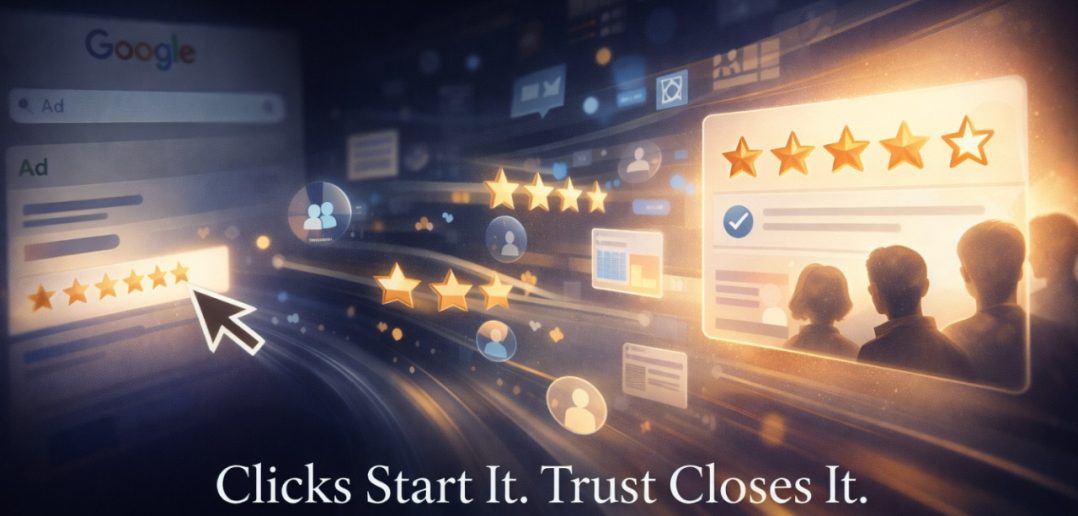
The implication is clear. The click initiates interest, but it does not close the decision.
The Rise of the “Invisible Research Phase”
What has changed in recent years is not just access to information, but the expectation of verification.
Consumers now assume that:
- Every business can be researched
- Every claim can be validated
- Every experience can be cross-checked
This has created what can be described as the invisible research phase. It is invisible because it does not show up clearly in attribution models, but it is where the decision is actually made.
During this phase, users are not looking for marketing messages. They are looking for confirmation. They want to know whether other people have had a positive experience, whether the business is consistent, and whether the brand appears credible across different touchpoints.
Studies indicate that 97% of consumers read reviews for local businesses, and many will not engage with a business without first doing so. In fact, 70% of consumers avoid visiting unfamiliar businesses without checking reviews first.
This is no longer a secondary behavior. It is the default.
Why Traffic Alone Is Becoming a Weak Signal
One of the more subtle shifts in marketing is the declining correlation between traffic and revenue.
It is entirely possible today to:
- Increase traffic but see flat conversions
- Run successful ad campaigns that generate clicks but no inquiries
- Rank well on search but lose customers to competitors
This happens because traffic measures attention, while conversions depend on trust.
If a user clicks through but encounters weak signals such as:
- Limited or outdated reviews
- Inconsistent messaging across platforms
- Lack of clear proof or credibility
they will continue their research elsewhere.
In contrast, a business with strong trust signals can convert even with lower traffic, because the decision friction is reduced.
Reviews Have Become the Conversion Layer
Among all trust signals, reviews have emerged as the most influential.
They function as:
- Social proof
- Risk reduction
- Validation of claims
Data consistently supports this. Nearly 79% of consumers trust online reviews as much as personal recommendations, and products with reviews are significantly more likely to be purchased. At the same time, 85% of consumers consider reviews essential when evaluating a business.
For local and service-based businesses, reviews are often the deciding factor. A potential customer may discover a business through an ad or search, but the final decision is heavily influenced by what others have said.
This is where many businesses underperform. They invest in traffic acquisition but treat reviews as passive outcomes rather than active assets.
In reality, review generation and management should be part of the marketing system itself. Platforms like Propel are built specifically to automate Google review collection and ensure a consistent flow of customer feedback, which directly strengthens trust signals at the point where decisions are made.
The Shift From Acquisition to Validation
This change fundamentally alters how marketing should be approached.
The focus is no longer just on getting discovered. It is on passing validation.
Every marketing channel now feeds into a single question the customer is asking:
“Can I trust this business?”
That question is answered not by ads or landing pages alone, but by a combination of signals:
- Reviews and ratings
- Website clarity and credibility
- Consistency across platforms
- Real customer experiences
This is why two businesses with similar traffic levels can perform very differently. One converts because it reduces uncertainty. The other loses customers during the research phase.
What This Means for Small Businesses
For small businesses, this shift is not a disadvantage. In many ways, it is an opportunity.
Larger brands often rely on scale and visibility. Smaller businesses have the ability to:
- Build closer customer relationships
- Generate authentic reviews more consistently
- Respond to feedback in real time
- Create more human, experience-driven content
These are exactly the signals that matter in the research phase.
The key is to treat trust as a system, not a byproduct. That means:
- Actively requesting reviews after every positive interaction
- Maintaining consistency across Google, website, and other platforms
- Addressing negative feedback transparently
- Ensuring that the customer experience aligns with the brand promise
The Strategic Mistake Most Businesses Are Still Making
Despite the shift, many businesses continue to allocate the majority of their effort and budget toward traffic generation.
They optimize:
- Ad creatives
- Keywords
- landing pages
But neglect:
- Review velocity
- Reputation consistency
- Post-click experience
This creates a mismatch. The front of the funnel is optimized, but the decision layer is weak.
The result is not a lack of demand, but a lack of conversion.
A Better Way to Think About the Funnel
The modern funnel is no longer linear. It is cyclical and validation-driven.
Discovery still matters. But it is only the entry point.
What follows is:
- Exposure
- Research
- Validation
- Decision
The most important stages are now the ones that happen after the click.
This requires a shift in mindset. Instead of asking how to get more clicks, businesses need to ask how to become the obvious choice during research.
Final Thought
Clicks still matter. They initiate the journey. But they are no longer the moment where decisions are made.
In 2026, conversion is less about persuasion and more about confirmation. Customers are not just looking for options. They are looking for reassurance that they are making the right choice.
Businesses that understand this will focus less on driving traffic alone and more on building the signals that close decisions. Those that continue to treat clicks as the primary goal will find themselves generating attention without outcomes.
The future of marketing is not about getting discovered.
It is about being chosen after being examined.