
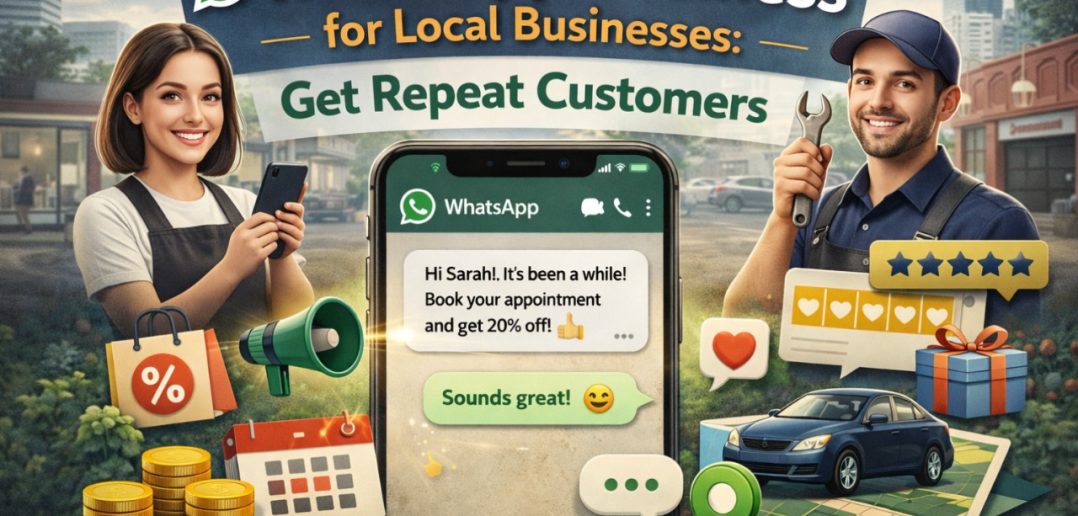
Acquiring new customers is expensive. Every business owner knows that, even if they don’t always quantify it.
Between paid ads, SEO, referrals, and promotions, a significant portion of your marketing effort goes into bringing someone in for the first time. But what happens after that first transaction is where most local businesses quietly lose revenue.
Customers who have already experienced your service are far more likely to come back. They don’t need convincing. They don’t need education. They need a timely reminder and an easy way to act.
This is where WhatsApp Business changes the equation.
Unlike email or social media, WhatsApp operates in a space where attention is almost guaranteed. Messages land directly in a personal conversation environment, which dramatically increases both visibility and response. For local businesses, this creates an opportunity to build a repeat-customer engine that runs consistently without heavy marketing spend.
Key Takeaways
- Repeat customers are significantly easier and cheaper to convert than new ones
- WhatsApp delivers higher open and response rates compared to traditional channels
- A structured messaging approach can increase bookings without increasing ad spend
- Personal, timely communication outperforms generic promotions
- Consistency and segmentation are critical to long-term success
Why WhatsApp Works Differently Than Traditional Channels
Most marketing channels are built around interruption. Emails compete with newsletters, promotions, and internal communication. Social media competes with entertainment, content, and endless scrolling.
WhatsApp sits in a completely different category.
It is a communication platform, not a content platform. Messages arrive in the same space where people interact with friends and family, which changes both how quickly they are seen and how they are perceived. This is why WhatsApp messages consistently outperform email in both open rates and response time.
For a local business, this shift is significant. Instead of trying to capture attention, you are operating in an environment where attention is already present. The challenge is no longer visibility. It is relevance.
Setting Up WhatsApp Business as a Customer Channel
Before sending any messages, the foundation needs to be set correctly. WhatsApp Business is designed with features that go beyond simple messaging and allow businesses to operate in a structured way.
A complete setup begins with your business profile. This includes accurate business information such as name, category, address, and operating hours. These details might seem basic, but they establish immediate credibility when a customer interacts with you.
The catalog feature allows you to present your services or products directly within the chat. This reduces friction by eliminating the need for customers to navigate away to a website. For service businesses, even a simple list of offerings with pricing can significantly improve conversion.
Quick replies and automated messages play a crucial role in maintaining responsiveness. Customers expect fast replies, especially on WhatsApp. Predefined responses ensure consistency while reducing manual effort. Similarly, away messages ensure that inquiries are acknowledged even outside business hours.
Finally, labels allow you to segment your customer base. This becomes increasingly important as your contact list grows. Without segmentation, messaging becomes generic. With it, communication becomes targeted and effective.
Building a Customer List That Actually Converts
The effectiveness of WhatsApp marketing depends entirely on the quality of your contact list. Unlike email, where businesses often rely on scale, WhatsApp rewards relevance and trust.
The most effective way to build a list is at the point of interaction. When a customer completes a purchase or service, that is the moment of highest satisfaction. Asking for permission to stay connected at that point leads to significantly higher opt-in rates.
Adding WhatsApp access points across your digital presence also strengthens this system. A simple link on your Google Business Profile, website, or social media allows interested customers to initiate contact themselves.
Incentives can accelerate this process. A small offer in exchange for joining your WhatsApp list often works well, especially for retail and service-based businesses.
However, one rule must be followed strictly: only message customers who have explicitly opted in. WhatsApp enforces strict anti-spam policies, and violating them can lead to account restrictions or bans.
What to Send: Message Types That Drive Repeat Business
The success of WhatsApp marketing is not determined by how often you message, but by what you send and when you send it.
Re-engagement messages are among the most effective. A simple reminder to a customer who hasn’t visited in a while can bring them back without the need for incentives. Timing is critical here. The message should feel natural, not forced.
Exclusive offers work particularly well for repeat customers. When positioned correctly, they reinforce loyalty rather than appearing as generic promotions. The language should reflect appreciation rather than urgency.
Appointment reminders are one of the most practical applications. They reduce no-shows and improve operational efficiency. For service businesses, this alone can justify the use of WhatsApp.
Seasonal promotions align your communication with customer needs. Instead of pushing offers randomly, you are responding to context. This increases both engagement and conversion.
Finally, loyalty-based messages acknowledge repeat behavior. Customers who feel recognized are more likely to return. Even simple gestures can have a meaningful impact on retention.
Automation Without Losing Authenticity
One of the concerns businesses often have is the time required to manage WhatsApp communication. In practice, much of this can be streamlined without losing the personal touch.
Quick replies handle frequently asked questions efficiently. Away messages ensure that no inquiry goes unanswered. Labels allow you to segment and target messages without additional effort. Broadcast lists enable you to reach multiple customers individually without creating a group environment.
For businesses looking to scale further, the WhatsApp Business API provides advanced capabilities such as automated workflows and analytics. However, for most local businesses, the standard application is more than sufficient to build an effective system.
Common Mistakes That Limit Results
WhatsApp is a high-trust channel, and misuse can quickly reduce its effectiveness.
Messaging without consent is one of the most common mistakes. It not only risks account restrictions but also damages customer trust.
Over-messaging is another issue. Unlike email, where frequency is more tolerated, WhatsApp requires restraint. Sending too many messages leads to disengagement and potential blocking.
Generic messaging also reduces effectiveness. Without segmentation, messages lose relevance. A customer who visits frequently should not receive the same communication as someone who has visited once.
The underlying principle is simple: every message should provide value.
A Real-World Perspective
A small salon with a limited customer base implemented a simple WhatsApp system focused on repeat engagement. Instead of investing heavily in acquiring new customers, they focused on reconnecting with existing ones.
They collected opt-ins during appointments, sent reminders at the right intervals, and offered occasional incentives to loyal customers. They also used appointment reminders to reduce missed bookings.
Within a short period, repeat bookings increased significantly, and reliance on paid advertising decreased. The growth did not come from expanding reach, but from improving consistency in communication.
Conclusion
For local businesses, growth is often framed as a problem of acquisition. In reality, it is just as much a problem of retention.
Customers who already trust your business represent the highest-value opportunity. The challenge is not convincing them again, but staying present in a way that feels natural and timely.
WhatsApp Business provides a channel that makes this possible. It removes friction, increases visibility, and enables direct communication without competing for attention.
When used consistently, it becomes more than a messaging tool. It becomes a system for building repeat business.
And over time, that system compounds.