
Summary
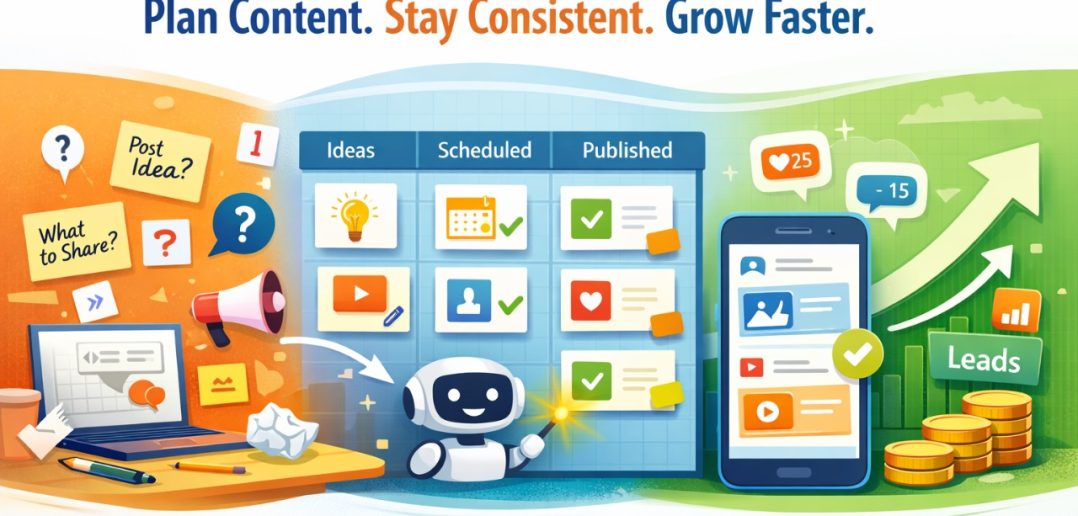
Creating content consistently is one of the biggest challenges for small and local businesses. It’s not because ideas are missing. It’s because there is no system to capture, organize, and execute those ideas over time.
A content calendar solves this problem. It gives structure to your marketing efforts and ensures that your content aligns with customer demand, seasonal trends, and business goals.
In this guide, you’ll learn how to build a practical content calendar that is simple to maintain, aligned with real-world business needs, and designed to generate visibility and leads.
Why Content Breaks Down for Small Businesses
Most small businesses don’t struggle with marketing intent. They struggle with consistency.
What usually happens is this: content starts with enthusiasm. A few posts go out in a week, maybe even daily. Then things slow down. Ideas start to feel repetitive. Other priorities take over. Within a few weeks, content disappears altogether.
This cycle is not a creativity problem. It is a planning problem.
Without a calendar, every piece of content becomes a new decision. And when every day requires a new decision, fatigue sets in quickly. Over time, the business defaults to silence.
A content calendar removes that friction. It shifts content from being reactive to being planned.
What a Content Calendar Actually Does
A content calendar is often misunderstood as just a posting schedule. In reality, it is a strategic tool.
It connects three critical elements:
- What your customers care about
- When they care about it
- How your business shows up in that moment
For local businesses, this becomes even more powerful because demand is rarely random. It follows patterns driven by seasons, urgency, and recurring problems.
For example, an HVAC business will see a spike in AC-related searches during summer and heating-related searches during winter. A content calendar ensures that your messaging aligns with these shifts instead of ignoring them.
Step 1: Start With Customer Demand
The biggest mistake businesses make is starting with content ideas instead of customer demand.
Instead of asking “What should we post?”, ask:
What are customers searching for right now?
What problems are they trying to solve this month?
What services are about to become urgent?
When you answer these questions, your content direction becomes clear.
Take a plumbing business as an example. During winter, content around frozen pipes and leak prevention becomes highly relevant. During monsoon or rainy seasons, drainage and water flow issues take priority.
By aligning content with demand, you ensure relevance. And relevance is what drives engagement.
Step 2: Define Clear Content Pillars
Once demand is clear, the next step is to organize your content into themes. This prevents randomness and creates consistency in messaging.
For most small and local businesses, four content pillars work extremely well.
The first is problem-based content. This focuses on answering real customer questions and addressing common issues. For example, “Why is my AC not cooling properly?” or “What causes low water pressure?”
The second is proof-based content. This includes testimonials, before-and-after visuals, and real job stories. It builds trust by showing actual results.
The third is authority content. This positions your business as an expert. It can include insights, trends, or advice based on experience.
The fourth is conversion-focused content. These are posts that directly encourage action, such as booking a service, limited-time offers, or reminders.
When content is grouped this way, planning becomes much easier. Every post has a clear purpose.
Step 3: Create a Weekly Content Rhythm
Instead of deciding what to post every day, create a weekly rhythm that repeats.
This reduces decision-making and builds consistency.
For example, a simple structure could look like this:
On Monday, you publish a problem-solving post that educates your audience.
On Wednesday, you share proof in the form of a testimonial or job highlight.
On Friday, you publish an authority or promotional post that nudges users toward action.
This rhythm works because it balances value, trust, and conversion. It also ensures that your content does not become overly promotional.
Step 4: Build a Monthly Calendar With Real Examples
Once the weekly rhythm is set, you can extend it into a monthly plan.
Let’s take a local HVAC business as an example.
In the first week of June, content may focus on early summer preparation. A post could explain how to reduce electricity bills during peak cooling season. Mid-week, a testimonial could showcase a successful AC installation. By the end of the week, a reminder post could encourage users to book servicing before demand peaks.
In the following week, the content could shift slightly toward maintenance and troubleshooting. Topics like “Signs your AC needs repair” or “Difference between servicing and replacement” become relevant.
What you’ll notice is that the calendar is not random. It follows the customer journey and seasonal demand.
Step 5: Use AI to Speed Up Execution
AI tools have made content creation significantly faster, but they should be used carefully.
They are most effective when used to execute a clear plan, not to create one.
For example, once your calendar is ready, AI can help generate captions, draft posts, design visuals, or even create short videos. This reduces the time required to publish content consistently.
However, the direction should still come from your understanding of your business and your customers. AI should support your strategy, not replace it.
Step 6: Keep the System Simple
One of the biggest reasons content calendars fail is overcomplication.
Businesses try to manage too many platforms, too many formats, and too many ideas at once. This quickly becomes unsustainable.
A better approach is to start small.
Focus on one or two platforms. Commit to two or three posts per week. Stick to a few clear content pillars.
Once this system becomes consistent, you can expand.
Simplicity increases execution. And execution is what drives results.
Key Takeaways
A content calendar is not about filling slots with posts. It is about aligning your content with how your customers think, search, and make decisions.
When done correctly, it reduces effort, improves consistency, and increases the impact of every piece of content.
Small businesses do not need more content. They need more structured content.
FAQs
How far in advance should I plan my content calendar?
Planning 2 to 4 weeks in advance works well. It provides structure while allowing flexibility for changes.
How many posts should a small business publish each week?
Two to three posts per week is a practical and sustainable starting point.
Do I need different content for every platform?
Not necessarily. You can create one piece of content and adapt it across platforms.
Can AI fully manage my content calendar?
AI can assist with execution, but the strategy should always come from your understanding of your business and customers.
Final Thought
Content becomes powerful when it is predictable, relevant, and consistent.
A content calendar is what makes that possible.
Instead of guessing what to post each day, you begin to operate with clarity. And over time, that clarity compounds into visibility, trust, and growth.