Article Summary
Local service businesses often assume that SEO success comes from ranking for large, competitive keywords or publishing more blog content. In reality, meaningful growth usually comes from aligning search visibility with real customer behavior.
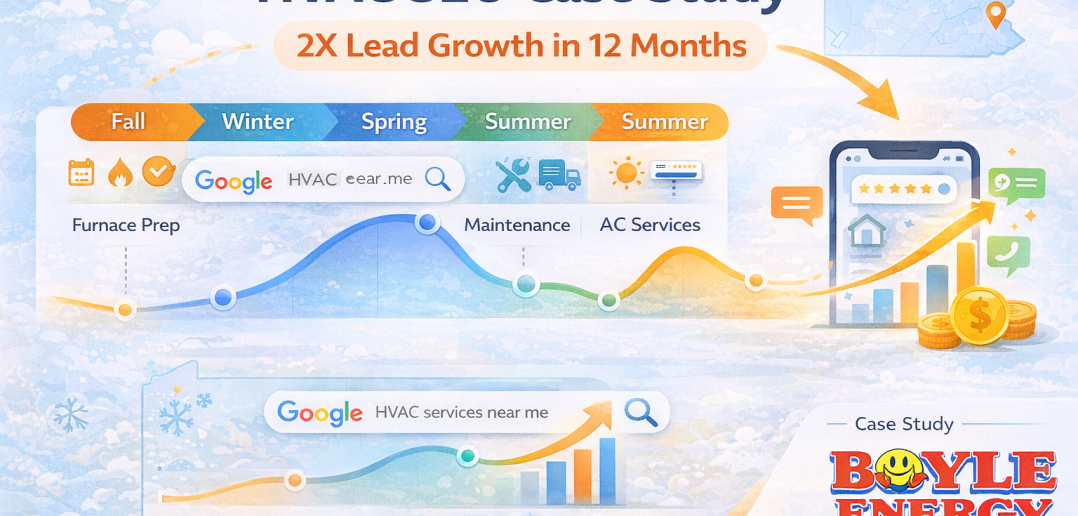
A recent HVAC and fuel delivery case study from Pennsylvania demonstrates this clearly. By aligning SEO strategy with seasonal demand cycles, optimizing Google Business Profile engagement, and targeting high-intent local keywords, the business achieved more than 2X year-over-year lead growth.
The campaign was executed by SocioSquares for Boyle Energy, a long-established home services company serving communities across Pennsylvania.
This article breaks down the strategy behind that growth and highlights the lessons local service businesses can apply to generate more qualified leads from organic search.
This HVAC SEO case study explores how a Pennsylvania home services business doubled inbound leads within 12 months using seasonal keyword strategy, Google Business Profile optimization, and conversion-focused website improvements.
The Challenge: A Strong Local Reputation With Limited Digital Visibility
Boyle Energy has served homeowners in Pennsylvania for decades, offering services such as:
- Heating oil delivery
- Propane delivery
- Furnace repair and installation
- HVAC installation and service
- Air conditioning maintenance
The company had a long-standing reputation in the region. However, their online presence did not reflect the strength of their offline brand.
Organic traffic was modest.
Google Business Profile engagement was inconsistent.
And inbound leads were lower than what the business potential suggested.
The objective of the campaign was simple.
Increase qualified inbound leads through organic search and Google Maps visibility.
Within twelve months, the results were significant.
Inbound lead volume grew by more than 100 percent year over year.
Why Seasonal Businesses Require a Different SEO Strategy
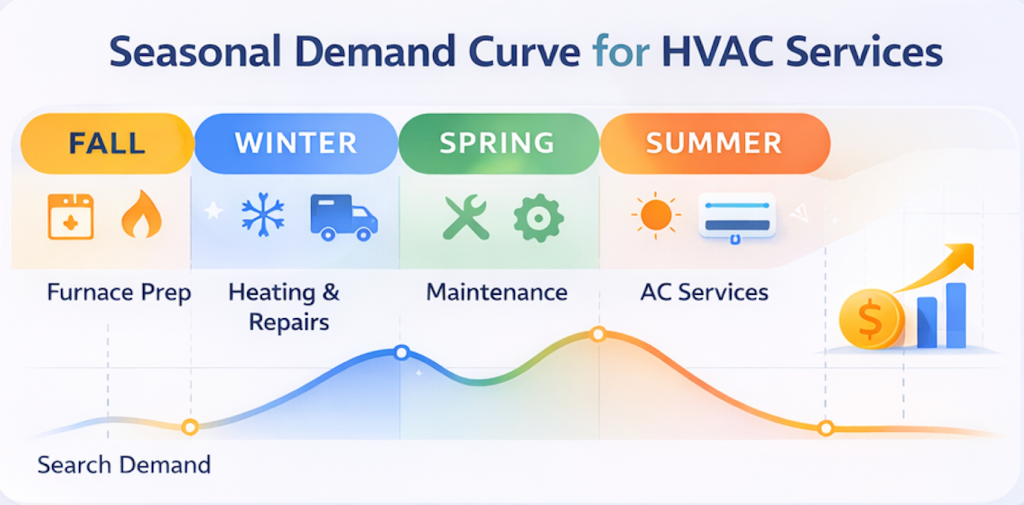
Industries like HVAC, fuel delivery, landscaping, and roofing do not experience consistent demand throughout the year.
Instead, demand rises and falls depending on weather patterns and homeowner behavior.
For example:
During winter in Pennsylvania, homeowners urgently search for:
- emergency furnace repair
- heating oil delivery near me
- propane refill service
During summer, the search demand shifts toward:
- Air conditioning repair
- HVAC installation
- AC tune-up services
Between those peaks are quieter months where homeowners research equipment upgrades or compare providers.
Traditional SEO campaigns often ignore these demand cycles.
Content gets published at random intervals, and keyword rankings are pursued without considering seasonal intent.
A more effective approach is to build the entire SEO strategy around seasonal demand signals.
That was the foundation of the Boyle Energy campaign.
The Strategic Shift: Targeting Buyer-Intent Keywords
Many SEO campaigns focus on broad keywords such as:
- Heating oil
- Propane company
- HVAC services
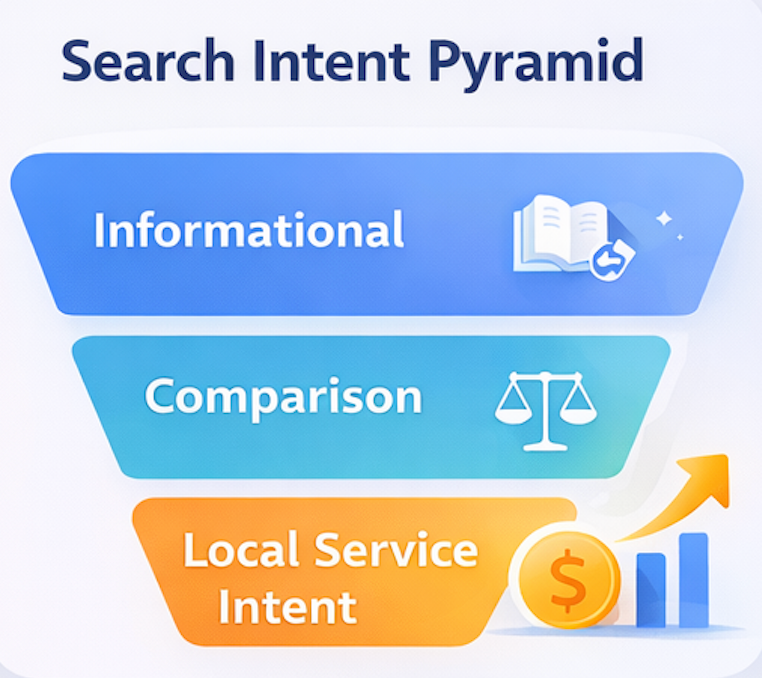
These terms generate traffic, but the intent behind them is often unclear.
Someone searching for “heating oil” could be doing research, comparing suppliers, or simply reading about energy options.
High-performing campaigns focus instead on bottom-of-funnel searches.
These queries usually contain geographic modifiers and service-specific terms.
Examples include:
| Generic Keyword | High-Intent Keyword |
| heating oil | heating oil delivery Havertown PA |
| propane company | propane heating companies near me |
| HVAC repair | emergency furnace repair Delaware County |
These searches represent homeowners who are much closer to making a decision.
Even if search volume is lower, conversion rates tend to be significantly higher.
Mapping Search Demand to the Seasonal Calendar
Once high-intent keywords were identified, search data was mapped to seasonal demand patterns using tools such as Google Trends and historical keyword data.
This allowed the campaign to develop a publishing and optimization calendar tied directly to consumer behavior.
Example Seasonal Strategy
September to October
Content focused on furnace maintenance and heating preparation.
November to February
SEO efforts prioritized heating oil delivery and emergency furnace repair searches.
May to August
The focus shifted to AC installation and air conditioning repair services.
Publishing content and optimizing pages before peak demand ensured the website had time to build rankings before search volume surged.
Google Business Profile: The Local Visibility Engine
For local service businesses, Google Business Profile often becomes the primary discovery channel.
When someone searches for services such as:
“heating oil delivery near me”
Google frequently displays the Local 3-Pack above traditional search results.
This makes the Google Business Profile listing a crucial conversion point, which is why Google Business Profile optimization plays an important role in improving local visibility and attracting qualified leads.
Key Improvements Implemented
Complete Business Information
Every profile field was reviewed and optimized, including service categories, geographic coverage, and business descriptions.
Photo Library Development
Images of technicians, service vehicles, installations, and office staff were added to increase credibility and engagement.
Profiles with photos typically generate more clicks and direction requests.
Seasonal Google Posts
Posts were scheduled around seasonal demand periods.
Examples included:
- Furnace tune-up reminders before winter
- Heating oil delivery offers during peak winter months
- Air conditioning maintenance promotions in early summer
Review Generation Process
Customers received a follow-up message after service completion with a direct link to leave a review.
Every review received a thoughtful response, reinforcing trust and engagement.
Website Optimization: Converting Visibility Into Leads
Search visibility only matters if visitors convert into leads.
A major part of the campaign focused on improving the website experience so visitors could easily contact the business.
Location-Based Service Pages
Instead of a single generic HVAC page, the website included pages targeting specific service areas such as:
- Havertown
- Springfield
- Delaware County
- Wayne
This hyperlocal structure allowed pages to rank for geographically specific searches.
Mobile Optimization
Most local service searches occur on smartphones.
The website was optimized for mobile usability and page speed to ensure visitors could quickly call or request service.
Structured Data Implementation
LocalBusiness schema and service-specific schema were added to reinforce search relevance signals.

Conversion Rate Optimization: Turning Traffic Into Calls
Driving traffic is only half the challenge.
Visitors must also take action. As part of our Landing Page Strategy for Local Services, we ensured that each page was structured not only to attract traffic but also to guide visitors toward taking action.
Several improvements were made to increase conversion rates.
Above-the-Fold Lead Capture
Service pages displayed phone numbers and contact forms immediately without requiring users to scroll.
Click-to-Call Buttons
Mobile users could call directly with one tap.
Trust Signals
The website highlighted:
- years in business
- technician certifications
- customer reviews
- service area maps
These elements reduce hesitation for first-time customers.
The Results
Within twelve months of implementing the strategy, Boyle Energy experienced significant growth.
Key outcomes included:
- More than 100 percent increase in inbound leads year over year
- Improved Google Local 3-Pack visibility across Pennsylvania markets
- Higher engagement with the Google Business Profile
- Increased organic traffic with stronger conversion rates
The growth was not the result of a single tactic.
It was the cumulative effect of:
- seasonality-driven keyword targeting
- strong local search optimization
- Google Business Profile management
- conversion-focused website design
Key Takeaways for Local Service Businesses
Several lessons from this campaign apply broadly to HVAC and home service companies.
Seasonality should shape SEO strategy.
Optimization efforts should begin months before peak demand periods.
Long-tail keywords drive better leads.
Specific, geo-targeted searches convert far more often than generic keywords.
Google Business Profile is a primary marketing channel.
It should be actively managed, updated, and optimized.
Traffic without conversions has limited value.
SEO and conversion rate optimization must work together.
This case study illustrates how SocioSquares implemented a structured local SEO strategy for Boyle Energy, combining seasonal keyword planning, Google Business Profile optimization, and conversion-focused website improvements.
The outcome was a measurable increase in inbound leads for a regional HVAC and fuel delivery provider.
Conclusion
The most successful SEO strategies rarely rely on shortcuts.
They focus on understanding customer behavior, aligning visibility with real demand, and ensuring every interaction, from search result to website visit, supports the decision to contact the business.
For seasonal service industries, this alignment between demand cycles and search visibility can make a substantial difference in lead generation and long-term growth.