Summary
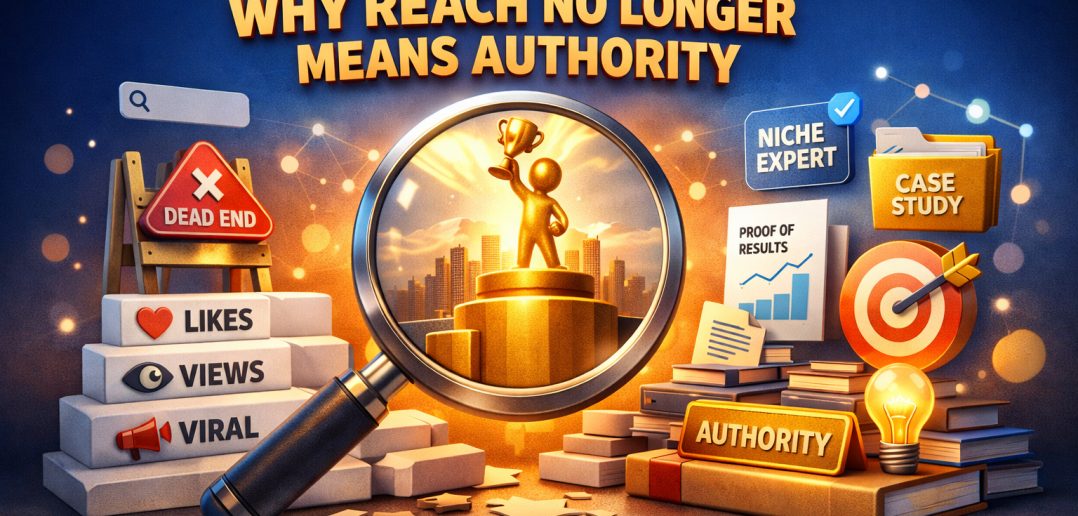
In 2026, LinkedIn has quietly redefined what success looks like. Big reach no longer guarantees influence. Viral posts no longer guarantee trust. And visibility without relevance fades faster than ever. The platform is shifting from rewarding broad engagement to rewarding topical clarity, meaningful interaction, and professional credibility. This article breaks down what has actually changed, why many creators feel their reach is unstable, and how authority is now built differently on LinkedIn.
The Illusion of Reach
There was a time when LinkedIn success was easy to measure.
You posted.
It got impressions.
It got likes.
It got comments.
More reach meant more authority.
Or at least that’s what we believed.
In 2026, that equation has quietly broken.
Some posts still go viral. Some profiles still rack up impressions. But reach alone no longer translates into credibility, influence, or inbound opportunities.
In fact, many professionals are experiencing something strange:
Their impressions fluctuate wildly.
Their content feels stronger than before.
Yet the business impact feels inconsistent.
That is not a coincidence.
It is a structural shift.
LinkedIn Has Changed What It Values
LinkedIn is no longer optimizing for loudness.
It is optimizing for relevance.
The feed is no longer just a popularity contest. It is a professional filtering system. The algorithm increasingly prioritizes:
• Topic consistency
• Reading time
• Meaningful comments
• Saves
• Profile depth
• Relationship strength
• Niche expertise
This means surface engagement signals like quick likes or broad appeal posts do less heavy lifting than they used to.
The platform is asking a different question now:
Is this person credible on this topic?
Not:
Is this post popular right now?
That subtle change has massive implications.
Why Reach Became a Weak Signal
Reach is exposure.
Authority is trust.
Those two are not the same.
A post can reach 200,000 people and generate zero qualified conversations.
Another post can reach 8,000 people and generate five inbound opportunities.
In 2026, LinkedIn’s distribution system appears to weigh contextual relevance more heavily than raw engagement.
You can observe it in the wild:
Highly niche breakdown posts often outperform generic motivational content in sustained visibility.
Creators who stick to tight themes see more consistent profile growth.
Posts that earn thoughtful comments travel further than posts that earn applause.
Authority compounds through depth, not spikes.
The Quiet Rise of Topical Identity
LinkedIn is increasingly building a topical map of who you are.
If you consistently post about:
• Performance marketing measurement
• AI agents for operations
• Local SEO for service businesses
• B2B sales pipeline strategy
The platform starts associating your profile with those clusters.
Over time, this builds what feels like a professional identity index.
This is why jumping between unrelated themes weakens discoverability.
The algorithm struggles to categorize you.
Authority requires repetition.
Not repetition of the same post.
Repetition of the same lane.
The Engagement Shift Most People Missed
Here’s what many overlook.
Not all engagement is equal.
Quick likes are easy.
Saves are powerful.
Time spent reading is powerful.
Thoughtful disagreement in comments is powerful.
Why?
Because those signals suggest the content triggered professional thinking, not passive scrolling.
LinkedIn increasingly seems to reward friction that produces insight.
This explains why educational document posts and deep breakdowns are performing strongly in many niches.
They hold attention.
They build memory.
They create return visits.
Authority grows where attention lingers.
The Death of Broad Thought Leadership
Generic thought leadership used to work.
Broad lessons. High-level advice. Universal quotes.
Now it feels thin.
In 2026, depth beats breadth.
The market is saturated with surface-level content.
Decision makers are looking for operators.
They want:
Specific use cases.
Real numbers.
Process breakdowns.
Context.
Experience.
The algorithm appears to align with that preference.
It surfaces content that signals lived experience over abstract inspiration.
Authority Now Lives in the Profile
If reach is unstable, where does authority anchor?
Your profile.
In 2026, your LinkedIn profile behaves like a landing page.
When someone discovers you, they are scanning for:
Clarity
Proof
Specialization
Relevance
If your headline is vague, your About section generic, and your experience unclear, reach cannot save you.
Authority is reinforced by consistency between:
What you post.
What your profile says.
What your network reflects.
When those align, the platform trusts you more.
And so do people.
The Creator Trap
Many professionals built growth strategies around maximizing impressions.
But impressions without positioning are unstable.
When reach dips, they feel invisible.
The better strategy in 2026 is different:
Optimize for recognition within a niche.
If the right 10,000 people know exactly what you stand for, you win.
Authority is not built by being seen by everyone.
It is built by being remembered by the right audience.
A Practical Authority Framework
If reach no longer equals authority, what does?
Here is a practical shift:
1. Pick 2 to 4 Core Themes
Not ten.
Repeat them consistently for 90 days.
Let the algorithm learn you.
Let your audience associate you with something specific.
2. Publish Depth, Not Volume
Instead of five shallow posts, publish one useful breakdown.
Ask yourself:
Would someone save this?
Would someone send this to a colleague?
Would someone revisit this in a month?
If yes, that is authority-building content.
3. Invite Real Conversation
Authority strengthens when people engage thoughtfully.
Ask for perspectives.
Encourage disagreement.
Add nuance.
The more your comment section resembles a professional discussion, the stronger your signal.
4. Optimize Your Profile Like a Category Page
Your headline should answer:
Who do you help and how?
Your About section should answer:
Why you and what proof supports it?
Clarity compounds.
Confusion dilutes.
Why This Is Good News
If you are serious about your work, this shift benefits you.
You no longer have to chase trends.
You do not need to manufacture virality.
You do not need to post daily motivational threads.
You need clarity.
You need repetition.
You need proof.
You need useful insight.
LinkedIn in 2026 is not rewarding noise.
It is rewarding positioning.
That is a more sustainable game.
The Goosebumps Moment
Here’s the realization that changes everything:
Reach is rented.
Authority is owned.
You can lose reach overnight.
You cannot easily lose authority once it is established.
If you focus on building recognition inside a tight lane, the platform becomes an amplifier instead of a slot machine.
And when someone searches your niche…
When someone asks for recommendations…
When someone thinks of that problem…
Your name surfaces.
Not because you shouted the loudest.
But because you stood in one place long enough to be known.
Final Thought
LinkedIn in 2026 is not about gaming the algorithm.
It is about becoming undeniable in a category.
If your reach feels inconsistent, do not panic.
Ask a harder question:
Are you optimizing for attention?
Or are you building authority?
The difference will define who compounds over the next five years.